
Robert M. (Bob) Young is a member of the Thoreau Society and the author of Tramping Monadnock! New Discoveries with Henry David Thoreau. The author thanks Digital Thoreau editors Paul Schacht and Beth Witherell for their assistance in writing this post.
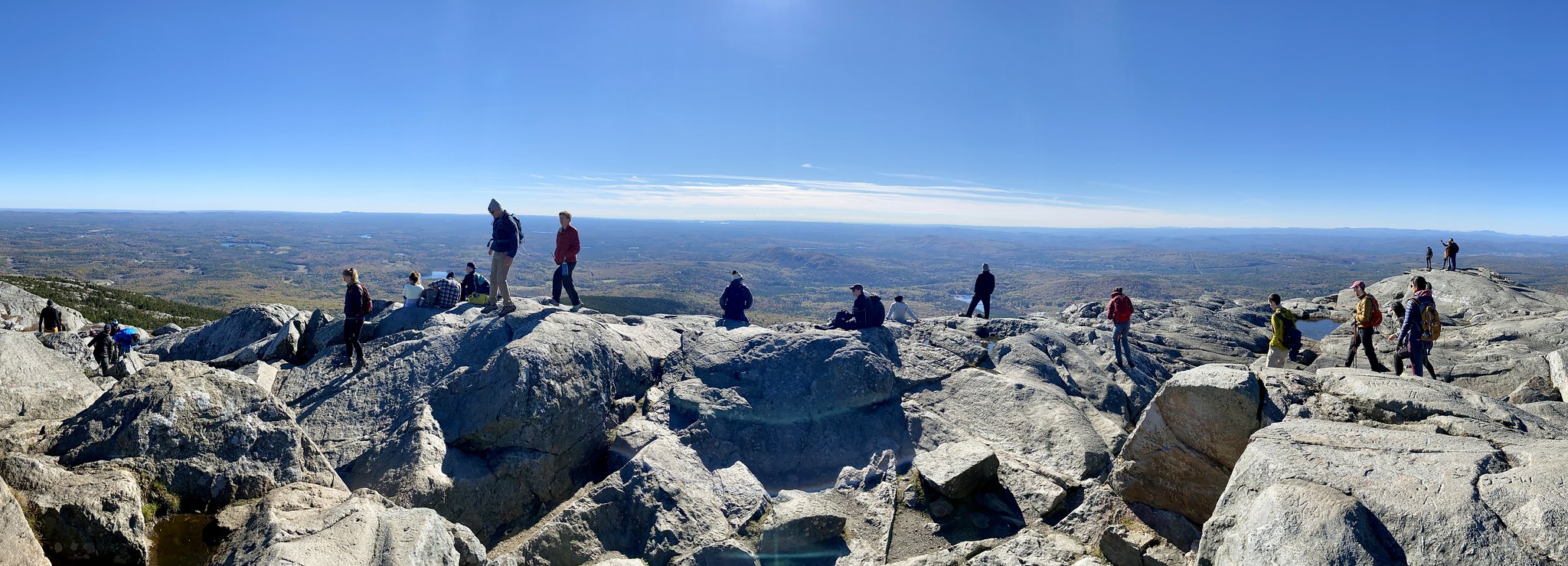
Climbers at the summit of Mount Monadnock. In Thoreau’s time as in ours, the mountain was a popular tourist attraction. Mt. Monadnock summit view by Robert Laliberte on Flickr, CC-BY-NC 2.0.
At 8:30 a.m. on August 4, 1860, accompanied by his close friend Ellery Channing, Thoreau set off from Concord on what was to be his fourth and final visit to “one of his favorite mountains,” as Walter Harding tells us: Mount Monadnock in New Hampshire (Harding 1982, 171). He’d made his first visit in 1844, traveling alone. Now, with Channing, “who had never been camping before,” he slogged “straight through a rainstorm,” writes Laura Dassow Walls, “to the very same hollow on Monadnock’s summit where he and [H. G. O.] Blake had camped two years before” (Walls 2017, 469).
In Journal entries dated August 4 through August 9, Thoreau provides a chronological account of the 1860 excursion. (See Journal 1906, 14:8-52.) In the entry for August 9, he includes lists and descriptions of the natural phenomena he observed, and he draws a map of the mountain that includes bearing lines and several of the features mentioned in his account.
In my self-published monograph Tramping Monadnock! New Discoveries with Henry David Thoreau (available in print from The Shop at Walden Pond, Lulu, or Amazon, and in several digital formats at the Internet Archive) I describe my effort to retrace Thoreau’s four journeys, walking the roads and paths he walked, riding the rail lines he rode, seeking, as I went, answers to a number of practical, scientific, and philosophical questions. For example, after his death, what became of the pocket compass that Thoreau used on his Monadnock journeys, as well as many others? (Spoiler alert: for a time, at least, it was in the possession of the poet Emma Lazarus. Chapter Eight of Tramping Monadnock! explains how she came into it and where it went next.) What did Thoreau learn about nature from these four trips? What did he learn about place? About life?