Digital Thoreau’s Manuscript Search Tool has a new feature: a table describing the 26 leaves of HM 924 Volume 8. Twenty-five of these leaves are handwritten; one is printed.
Why have we put the leaves of Volume 8 in their own table?


Digital Thoreau’s Manuscript Search Tool has a new feature: a table describing the 26 leaves of HM 924 Volume 8. Twenty-five of these leaves are handwritten; one is printed.
Why have we put the leaves of Volume 8 in their own table?
Today marks one year since the passing of Ronald Earl Clapper, whose 1967 UCLA dissertation “The Development of Walden: A Genetic Text” is the basis of Digital Thoreau’s Walden: A Fluid-Text Edition.
From its first appearance, Ron’s genetic text of Walden has provided the Thoreau scholarly community with a tool of incalculable benefit. It’s been widely cited in books and articles, especially those seeking to understand Thoreau’s most important work through the lens of its long and complicated evolution. As correctly noted in this tribute on the website of California State University Fullerton, where he held a faculty appointment beginning in 1974, Ron’s dissertation has been “universally acknowledged as an indispensable and foundational resource—one scholar has referred to it as a ‘bible’—for serious Thoreau scholarship.”
I’m excited to announce the latest addition to Digital Thoreau: an electronic version of William Rossi’s essay “Making Walden and Its Sandbank,” which first appeared in print in the Concord Saunterer Vol. 30 n.s. (2022), 10–58. Rossi is co-editor of two volumes of Thoreau’s Journal in The Writings of Henry D. Thoreau, published by Princeton University Press, and (with John Lysaker) of Emerson and Thoreau: Figures of Friendship (Indiana UP, 2009). He also edited the Norton Critical Edition of Walden, Civil Disobedience and Other Writings (3rd edition, 2008).
Making Walden and Its Sandbank revisits one of the most famous passages of Walden—Thoreau’s description, beginning in paragraph 6 of “Spring,” of the “forms which thawing sand and clay assume in flowing down the sides of a deep cut on the railroad through which I passed on my way to the village”—in light of what the Walden manuscript reveals about just when and how Thoreau first drafted, and subsequently revised, the passage. The essay represents an important new contribution to our understanding of both Walden’s and Thoreau’s development. As explained in the abstract to the Saunterer version of the essay:
Close and contextual analysis of Thoreau’s early expansion of Walden’s famous sandbank passage provides considerable insight into his shift toward greater literary and scientific naturalism. Together with its subsequent revisions, this passage, drafted in the spring 1848 Journal six or seven months after he left the Pond, already comprises the core of the narrative’s universally celebrated climactic epiphany. Although scholars have long known of its existence, when its revisions are dated and examined in the contexts of the Walden manuscript’s development, Thoreau’s practice of using the Journal to compose Walden material, the contemporary evolution debate, and his engagement in what historians call “public science,” this remarkable event can be seen both to illuminate and to complicate Thoreau’s career-defining “turn to science” in the early 1850s.
After Rossi generously agreed to republish his essay here, Digital Thoreau editor (and Writings Editor-In-Chief) Elizabeth Witherell and I worked with him to develop a web presentation of his content designed to improve the readability of his manuscript transcriptions and allow readers to compare those transcriptions directly to the corresponding manuscript images in the Huntington Library’s digital collection. To embed the Huntington’s IIIF-compliant images in the essay, we used the community-developed, open source Universal Viewer.
Our collaboration with Rossi led to additional refinements of the essay, as the three of us took a deep dive into the manuscript’s interlineations, cancellations, marginal notations, and “overwritten” stretches (where Thoreau replaced words or letters by writing new ones directly on top of them) and gained additional insight into some of Thoreau’s changes. Preparing the essay for web publication also provided an opportunity to tighten the terminology used to describe the various stages of composition represented on the manuscript.
It’s worth comparing Rossi’s detailed analysis of the sandbank passage’s evolution with the revision model presented in Digital Thoreau’s fluid-text edition as a measure of how much there is still to learn about the timing and content of Thoreau’s revisions, and about the relationship between Walden and Thoreau’s other writings, especially the Journal. “Making Walden and Its Sandbank” will undoubtedly provoke new conversations about Walden’s development, Thoreau’s revision process, and the meaning of a passage central to any understanding of both the book and Thoreau’s thought. It should also bring renewed appreciation for the Huntington’s decision to digitize and freely share one of its most precious holdings and an invaluable resource for both scholars and the general reading public.
I’m excited to announce that Digital Thoreau has embarked on a new project, funded by an Innovative Instruction Technology Grant from the State University of New York, to produce a fresh encoding of HM 924, the manuscript of Walden.
The grant has made it possible for the Huntington Library to digitize the manuscript and host the manuscript images in its Digital Library, where they can be freely accessed by the public.
The grant team will create online open educational resources on the practice of digital scholarly editing, using the Walden manuscript as a “laboratory” for introducing learners to principles, issues, and tools central to scholarly editing in general and the production of digital scholarly editions in particular.
Whether using these modules as part of a class or on their own, learners will have the opportunity to develop and hone their documentary editing skills by contributing to a brand-new encoding of the manuscript. Using an interactive transcription interface, they’ll be able to view the manuscript images and identify a variety of manuscript features (such as Thoreau’s insertions and cancellations) either through a suite of editing tools or by directly entering XML-TEI.
This new manuscript encoding will serve as an invaluable companion to Digital Thoreau’s current fluid-text edition of Walden, based on a collation of witnesses across the manuscript’s seven draft versions undertaken by Ronald E. Clapper for his 1967 PhD dissertation, The Development of Walden: A Genetic Text. In the intervening years, there has been no comparable effort to chart the evolution of Thoreau’s masterpiece by examining his extensive rewriting and redeployment of passages as the manuscript grew between 1846 and its publication in 1854. We expect that the Huntington’s high-resolution scan of the manuscript will yield numerous new insights and permit the correction of various errors.
The team collaborating on the SUNY grant-funded project, A Laboratory-Based Introduction to Digital Scholarly Editing, includes the following scholars:
Happy 200th Birthday, Henry David Thoreau! In your honor, we’ve added a new text to The Readers’ Thoreau, Digital Thoreau’s platform for reading Thoreau socially.
The text is “Walking,” one of Thoreau’s most popular essays, published in 1862.
As our “Note on the Text” explains,
Start reading “Walking” now or register an account on the main site and join the public group “General Discussion” to start a conversation in the margin.
The Thoreau Society is trying something new for its 2016 Annual Gathering, the 75th since the society was founded by a small group of Thoreauvians led by Walter Harding in 1941. The Society is asking all presenters to consider putting the text of their presentations on Digital Thoreau’s community site for reading Thoreau socially, The Readers’ Thoreau. Readers interested in Thoreau and his times will be able to follow the Annual Gathering’s proceedings online, and Readers’ Thoreau members (membership is free!) will be able to comment on the presentations right in the margin, as they can already do with Walden and “Resistance to Civil Government” (aka “Civil Disobedience”).
The aim is to enrich the conversation, both during and after the Gathering, about the intersection of Thoreau and nineteenth-century literature, history, science, and philosophy, while also giving the world at large a glimpse of the wide-ranging discussion that characterizes the yearly four-day convergence of Thoreauvians in Thoreau’s home town of Concord, MA. Readers’ Thoreau members (did I mention that membership is free?) will be able not only to comment directly on presenters’ texts but also to message one another directly through the site and exchange ideas in a dedicated discussion forum for the 2016 Gathering.
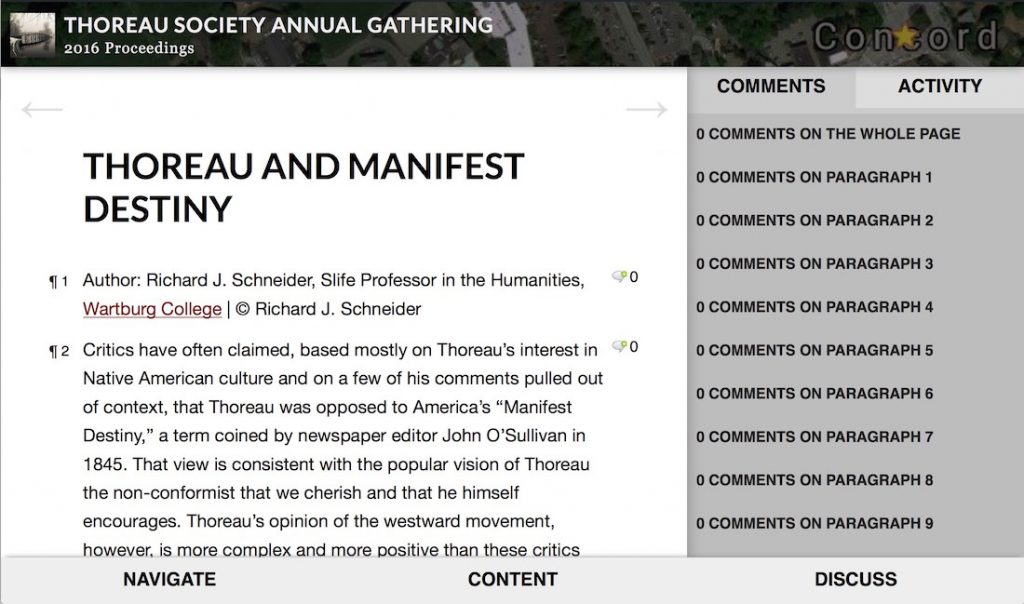
The design of The Readers’ Thoreau network will enable both presenters and commenters to link references to Walden and “Resistance” directly to passages in the network’s editions of these texts, and to add comments on the texts that link directly to the papers from the Gathering.
Some authors have agreed to post copies of their papers even before the Gathering begins, which should make for livelier and more thoughtful face-to-face exchanges in their sessions; others have agreed to post after they’ve had a chance to share their ideas live.
A couple of papers are already up on the site; we’re looking forward to adding more, and to making this kind of sharing and engagement an integral part of future Gatherings.
This spring, about two dozen students in two sections at Duke Kunshan University in Kunshan, China are taking “Walden International: Analyzing Thoreau Across Cultures” from Patrick Morgan, a Ph.D. candidate and Graduate Instructor in English at Duke University and a graduate of SUNY Geneseo (English, Geological Sciences, 2010).
Morgan’s Kunshan students are discussing Walden in the margins of Thoreau’s work at The Readers’ Thoreau, the online community of Digital Thoreau.

The students are also “analyzing [Thoreau’s] writings from an international perspective, focusing primarily on his engagement with Asian thought,” according to Morgan’s syllabus, asking how Thoreau “‘package[s]’ ancient Asian philosophies in order to comment on nineteenth-century American culture” and what “cultural forces and contexts … allow scholars like Lin Yutang to claim Thoreau as ‘the most Chinese of all American authors.'”
In addition to meeting with Morgan for 300 minutes each week in class and exchanging ideas online in the margins of Walden, the Kunshan University students are taking a digital field trip to Walden Pond thanks to a website Morgan has created that links passages of Thoreau’s text to YouTube videos he made in which he reads aloud from Walden while capturing the pond’s sights and sounds.
Morgan has been active in Thoreau studies since his undergraduate days at Geneseo, where he presented on “Thoreau’s Bedrock: Emerson’s Influence and the Geomorphological Significance of Emerson’s Cliff, Concord, Massachusetts” for Geneseo’s day celebrating undergraduate research, GREAT Day, in 2010. That same year, his article on “Aesthetic Inflections: Thoreau, Gender, and Geology” appeared in the Thoreau Society’s scholarly annual, The Concord Saunterer. In 2015, Morgan participated in an NEH summer institute for college instructors on “Transcendentalism and Reform in the Age of Emerson, Thoreau, and Fuller” conducted in Concord by a roster of scholars that included Sandra Harbert Petrulionis, Phyllis Cole, Jayne Gordon, Robert Gross, John Matteson, Wesley T. Mott, and former Geneseo Harding lecturers Laura Dassow Walls, Megan Marshall, and Joel Myerson.
In addition to his studies and teaching at Duke University, Morgan serves as an editorial assistant at the scholarly journal American Literature, published by Duke University Press.
Today, we’re thrilled to announce that two of our projects at Digital Thoreau — Walden: A Fluid Text Edition and The Readers’ Thoreau — are ready to use.
Walden: A Fluid Text Edition enables readers to track Henry David Thoreau’s revisions to Walden across the seven manuscript versions he composed between 1846 and 1854.
To create it, we’ve taken the critical apparatus of the manuscript versions first prepared by Ronald E. Clapper in his 1967 Ph.D. dissertation The Development of Walden: A Genetic Text and encoded it in TEI. When displayed in the Versioning Machine, open-source software first developed under the editorship of Susan Schreibman, our TEI makes it possible to compare any of the seven versions with any other or with the base text, the Princeton University Press edition of Walden. To produce our fluid-text Walden, we worked closely with Prof. Clapper; Elizabeth Witherell, editor-in-chief of Princeton’s The Works of Henry D. Thoreau; and Syd Bauman, XML Programmer-Analyst at Northeastern University Libraries. We gratefully acknowledge their assistance and the cooperation of Princeton University Press.
The Readers’ Thoreau embeds the published version of Walden in a social network, making it possible for readers to form groups to discuss Thoreau’s classic in the margins of the text and in discussion forums. Funded largely by a State University of New York Innovative Instruction Technology Grant, The Readers’ Thoreau is built entirely with open-source tools and has resulted in improvements to those tools that will benefit everyone who uses them. The social network is provided by Commons In A Box, a WordPress plugin developed at City University of New York, and the in-text social reading capability comes from another plugin, CommentPress. The current lead developer of CommentPress, Christian Wach, has written new code that tightens the integration between the two plugins and adds many new affordances to the CommentPress interface, including more granular visibility settings, the ability to “like” and feature comments, and the ability to let selected users enrich their comments with media. Readers will be able to filter the comments that are visible to them so that they see only those they care about. In addition, all readers will be able to follow discussion among a “panel of experts” — readers whose knowledge of Thoreau gives their contributions to the discussion added interest and value. We’ve seeded these expert comments with the late Thoreau scholar Walter Harding’s annotations to his 1995 edition of Walden.
We have a third, ongoing project at Digital Thoreau: The Days of Walter Harding, Thoreau Scholar. The Days is an effort by undergraduate digital humanists at SUNY Geneseo to explore the life and work of a pre-eminent Thoreauvian who helped to found the Thoreau Society in 1941, produced numerous scholarly books and articles on his subject — including the influential biography The Days of Henry Thoreau (1965) — and taught at Geneseo from 1956 to 1982, where he achieved the ranks of SUNY Distinguished Professor and University Professor. Using the open-source archiving platform Omeka, Geneseo students are digitizing materials from Harding’s vast trove of Thoreauviana and organizing them into online exhibits.
We’re excited about all three of these projects. We hope you’ll visit them here and send us your feedback.
Promoting public engagement with Thoreau’s works is an important goal for Digital Thoreau. The internet has opened a world of possibilities for social reading: a way to share ideas about a text through comments linked to particular passages.
To explore how we might create the richest and most flexible social reading experience of Thoreau’s Walden, Digital Thoreau is bringing together academics and other professionals interested in social reading for THATCamp Western New York, which will be hosted by SUNY Geneseo February 18-19, 2013. THATCamp Western New York is generously funded by an Innovative Instruction Technology Grant from the State University of New York.
Code for America fellow Eddie Tejeda, the creator of Digress.it and the lead developer of Regulation Room, will be among the participants.
Learn more at the website for THATCamp Western New York, and follow @thatcampwny on Twitter.
Okay – and a few seconds. We created this project pitch video for our page at DHCommons an initiative of centerNet. DHCommons matches digital humanities projects in need of assistance with scholars looking for projects to join.
Digital Thoreau from Paul Schacht on Vimeo.